
Garrard County Criminal Court Cases
Garrard County and Jessamine County form Kentucky's 13th Judicial Circuit and District. The court level tells a searcher where a criminal case stands. Garrard Circuit Court hears felony prosecutions after indictment. Garrard District Court hears misdemeanors, traffic charges, county or city ordinance cases, and preliminary felony matters. A complaint, citation, or warrant may first appear in District Court even when the prosecution later moves to Circuit Court. The arresting agency does not decide which clerk holds the final court record.
Both local court levels use the Office of Circuit Court Clerk at the Garrard County Justice Center. Clerk Dana Hensley's office is at 54 Stanford Street, Lancaster, Kentucky 40444. The main number is 859-792-2961, and posted hours are weekdays from 8 a.m. to 4 p.m. The same office can address source files from Circuit and District Court, including requests for plain or certified copies.
The official Garrard court page shows the local records counter and calendar. That source also provides a useful view of where Garrard County criminal case files are maintained.
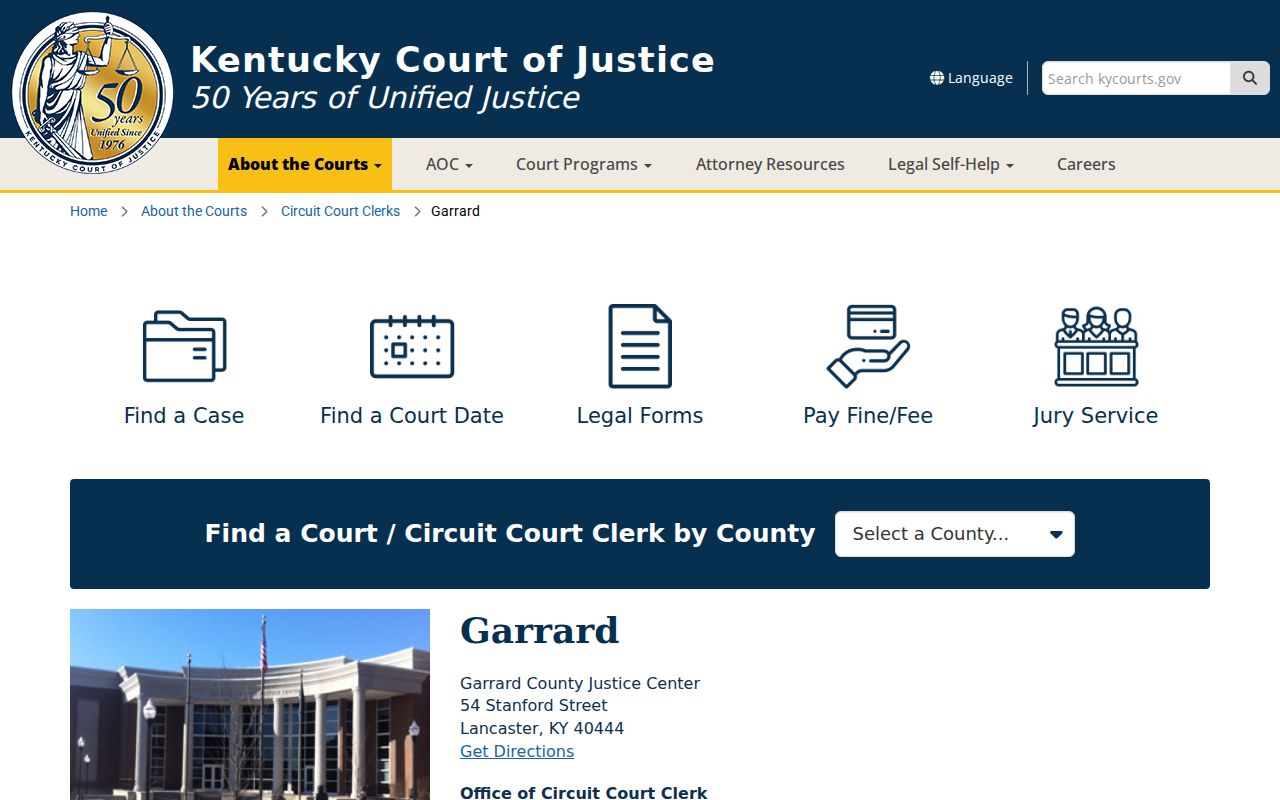
The image reinforces a key search rule: court pleadings and judgments begin with the clerk, not with a jail or arrest log.
Garrard County Case Court Levels
Sorting the matter by court level saves time. District Court holds the early record of a felony complaint, initial appearance, bond decision, and any preliminary hearing. If a grand jury returns an indictment, the later felony prosecution belongs in Circuit Court. A misdemeanor generally remains in District Court. Lancaster has no separate municipal court, so city ordinance cases also use Kentucky's unified District Court system.
| Court | Garrard County case work | Local schedule |
|---|---|---|
| Circuit Court | Felony prosecutions after indictment | Criminal court, third Friday at 9 a.m. |
| District Court | Misdemeanors, traffic, ordinances, felony preliminaries | Monday at 9 a.m.; Thursday at 1 p.m. |
| Family and related dockets | Family, domestic violence, and protected matters | See the official Garrard court calendar |
A docket day is not a promise that a specific case will be heard then. Use the case number to check the current event entry, and call the clerk before relying on a general schedule. Family, juvenile, and victim-sensitive records may have tighter access rules than an ordinary adult criminal docket.
Searching Garrard County Case Records
KYeCourts Guest CourtNet is the free statewide starting point. Its public landing page presents a Google reCAPTCHA check and a Continue button. Research could not verify the field controls behind that gate, so a searcher should not assume that every common filter will appear. CourtNet is a location tool. It is not a certified court file, and Kentucky's own guidance says important facts should be checked against the official record.
- Open Guest CourtNet and complete the reCAPTCHA gate.
- Use the available party or case controls to locate the Garrard County matter.
- Match the county, court level, filing context, and party before treating the result as relevant.
- Write down the case number and the document or docket entry needed.
- Call or visit the Garrard Circuit Court Clerk to verify the outcome and request a plain or certified copy.
| Visible field or control | Type | Required | Use |
|---|---|---|---|
| Google reCAPTCHA | Checkbox | Yes at entry | Clears the public guest gate |
| Continue | Button | Yes at entry | Moves from the landing screen |
| Downstream case fields | Gated controls | Not verified | Check the live interface; do not rely on guessed labels |
| Case number | Clerk reference | No | Helps the clerk identify the source file |
The official Guest CourtNet screen is shown in the Kentucky Court of Justice guest entry.
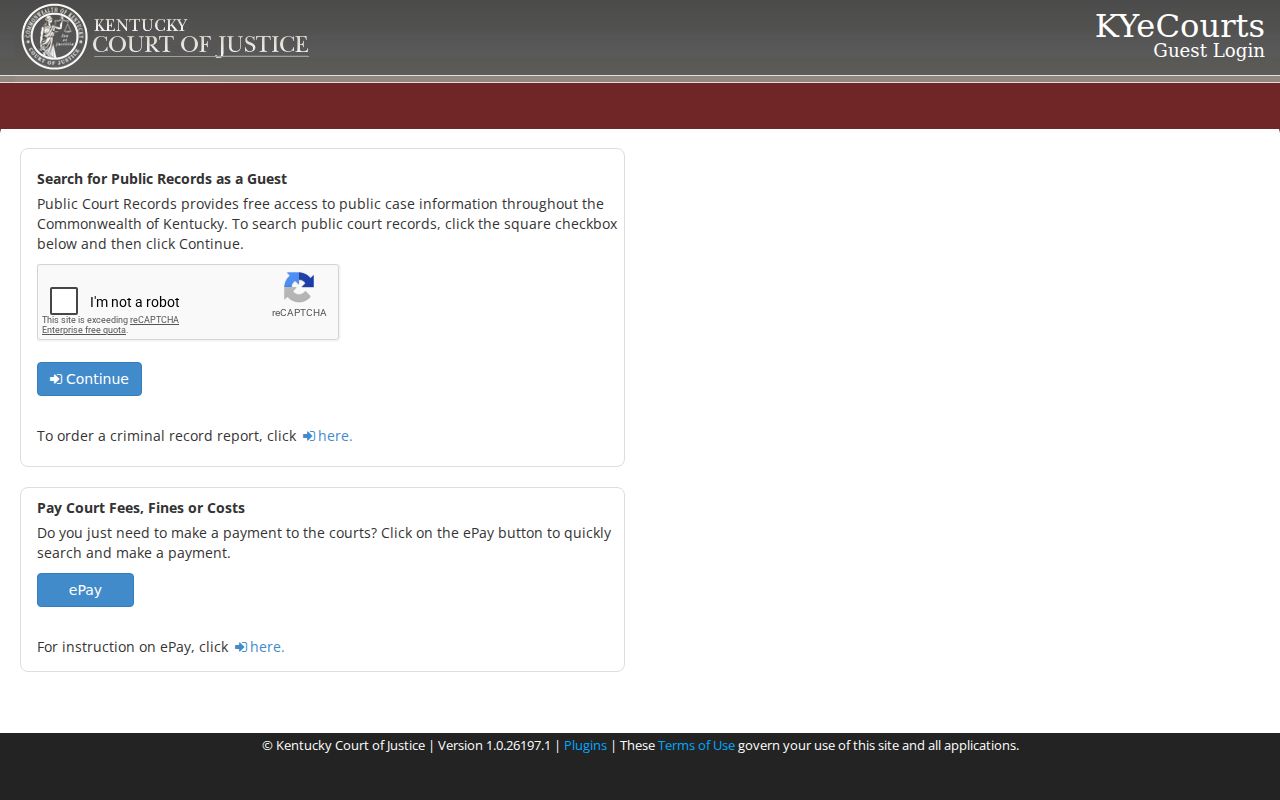
The gate explains why the clerk's phone and counter remain essential when the public search does not advance or does not locate an older matter.
Garrard County Criminal Docket Days
Garrard Circuit criminal court is scheduled for the third Friday at 9 a.m. District Court meets Monday at 9 a.m. and Thursday at 1 p.m. Those days help a reader understand docket entries, yet they should not be used to infer an outcome. A scheduled hearing can move, be continued, or address only one issue. The clerk's current docket and the signed order control.
Bond entries also require close reading. The Justice Center page says cash is required for bond there, while eligible court payments may accept cash, personal check, money order, credit card, or debit card, with a card fee. Those are separate transactions. A person resolving a bond question should ask which location will take payment, the exact amount, and whether a new order has changed the terms.
Note: A posted court calendar describes the usual Garrard County schedule, not a guarantee that one named case remains set.
Inside a Garrard County Case File
A Garrard County criminal case file centers on one prosecution. It may begin with a complaint, citation, warrant return, or indictment. The docket then records hearings and filings in date order. Orders can address release, counsel, discovery, motions, pleas, trial, judgment, sentence, restitution, or later revocation activity. The source file may show facts that a short online event label cannot convey.
| Case number and court | Identifies the prosecution, county, and District or Circuit Court level. |
|---|---|
| Charging document | Shows the complaint, citation, or returned indictment and the charges then before the court. |
| Docket entries | Lists filed events, hearings, motions, and orders in chronological form. |
| Bond and hearing data | Records release terms, scheduled proceedings, and later changes entered by the court. |
| Disposition and judgment | States how each filed charge ended, which may include conviction, dismissal, diversion, or another result. |
| Sentence and later activity | May include confinement, probation, restitution, payment, revocation, appeal, or expungement orders. |
A booking accusation is not a court disposition. Charges can be amended, dismissed, or replaced as the prosecutor reviews the proof. One case may also contain several charges with different outcomes. For that reason, use the most recent signed order and disposition rather than an arrest description when determining what the court decided.
Older Garrard County Criminal Files
A missing online result does not prove that no Garrard County court record exists. The clerk reports that older files may remain in the office, sit at an off-site record facility, or have been destroyed under judicial retention schedules. If a public file is stored elsewhere, the clerk can provide the facility and the case or file locator numbers needed to retrieve it.
Prepare the party name, approximate filing year, known case number, and desired document title before calling. Ask whether the file is onsite, whether retrieval needs advance notice, and whether the requested copy can be certified. The official Garrard court page does not publish a criminal-copy price. The clerk should quote the current fee and accepted payment method rather than having a searcher borrow a fee from another county or state service.
The Kentucky Court of Justice provides formal court record request instructions for trial records. Its request page illustrates the statewide route for records that a simple docket search cannot supply.
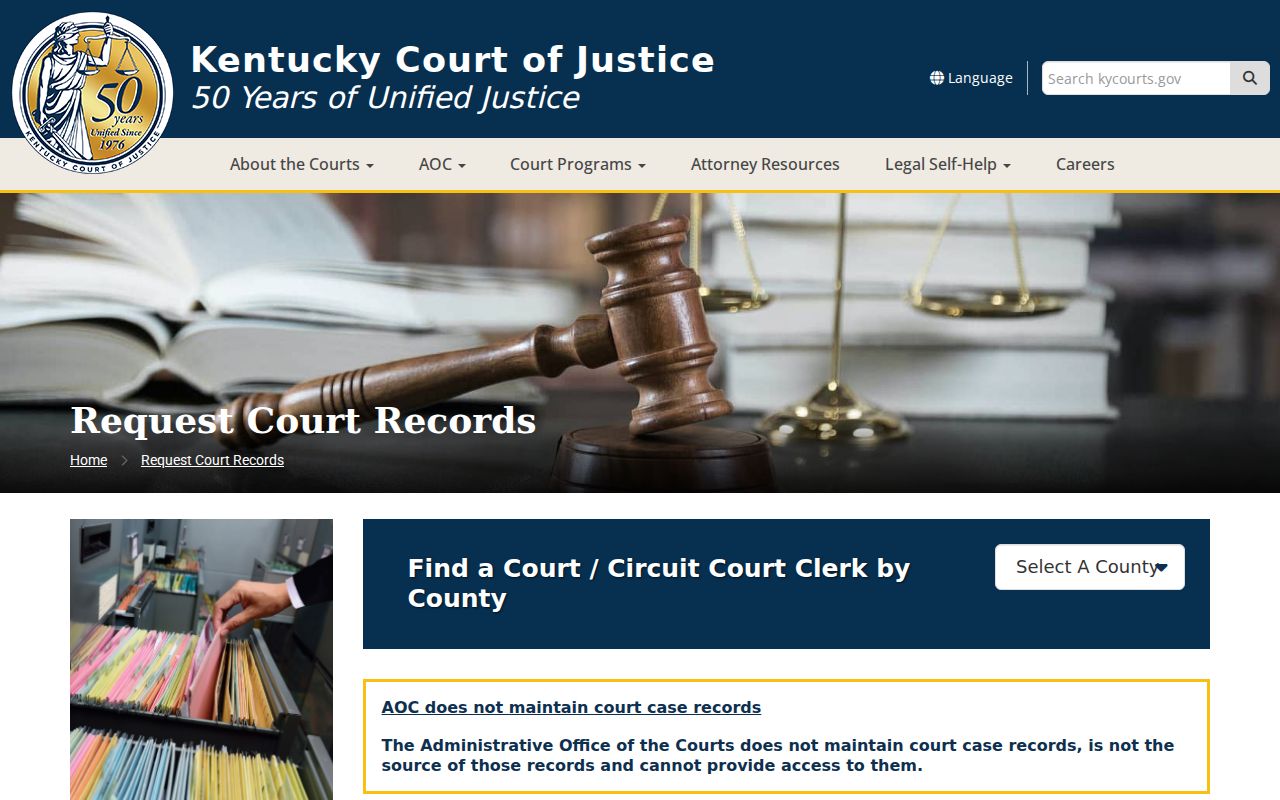
The request channel is especially useful when a Garrard County file is old, stored, or needed as an official copy rather than as an online lead.
How a Criminal Case Moves
A felony case often starts in Garrard District Court with an initial filing and arraignment. The judge can address release and probable cause. A preliminary hearing may result in dismissal, waiver, or a finding that the matter should proceed. The grand jury may then return a true bill, meaning an indictment, or a no bill, meaning no indictment. After indictment, Circuit Court records the later felony proceedings.
Garrard County case flow: Charges Filed › Arraignment › Pretrial › Plea or Trial › Disposition › Sentencing
A misdemeanor normally stays in District Court. In either court, a plea is the defendant's formal response, while a disposition is the outcome of a charge. Post-judgment filings can include probation terms, restitution, a motion to revoke, an appeal, or an expungement order. Each stage adds a new court record, so the latest docket entry may be more useful than the first charge.
Garrard County Case Outcome Terms
Short docket labels can be easy to misread. “Disposed” only means the court entered an outcome. It does not mean every charge produced a conviction. Likewise, a pending case is unresolved and does not establish guilt. Garrard County's FY2023 AOC statistics counted charge dispositions, not unique people and not a county crime rate.
- Conviction
- A judgment of guilt entered after a plea or verdict.
- Dismissal
- A charge ended without a conviction on that count.
- Diversion
- A supervised route that can avoid an ordinary conviction if its terms are completed.
- FTA or FTV
- A procedural category for failure to appear or failure to verify, not a new conviction by itself.
- Disposition
- The recorded outcome of a charge or case.
In FY2023, Garrard Circuit disposed 441 felony-level charges within 275 circuit criminal cases. The report listed 187 conviction dispositions, 129 dismissals, 60 FTA or FTV entries, 46 diversions, 13 administrative outcomes, and six other outcomes. Those figures describe court workload. They cannot answer whether a specific person was convicted.
Garrard County Court Files Versus Histories
A Garrard County court file and a KSP centralized criminal history serve different purposes. The court file follows one case number, with its pleadings, events, orders, disposition, and sentence. KSP compiles reportable criminal-history data from agencies across Kentucky. KRS 17.150 does not open that central compilation to ordinary public inspection, though KSP offers a separate consent-based adult check.
Timing can create a mismatch. A clerk's file may show a dismissal before the repository updates. A recent arrest may not yet have a filed case. Spelling differences, incomplete disposition reporting, and expungement can also change what appears. For a question about a Garrard County prosecution, the clerk's signed judgment and disposition are the best source. The wider Garrard County criminal history overview explains when KSP, jail, and DOC records answer different questions.
Case Record Access & Restrictions
Kentucky court access does not make every filed detail public. Juvenile material, sealed or expunged records, protected victim information, personal identifiers, and some active or sensitive content may be removed or withheld. Grand-jury deliberations remain secret even if a returned indictment becomes part of the court record. A public docket label may also summarize an order without showing its full text.
The Kentucky Open Records Act sets procedures for nonexempt public records, while KRS 17.150 governs access to investigative and centralized criminal-history material. Neither route overrides a seal, juvenile confidentiality, victim protection, or a lawful redaction. Ask the office that holds the source record: the Circuit Clerk for court documents, and the originating police agency for its own report.
When a visible record appears wrong, compare the case number, court, charge, and latest signed order. Then ask the clerk about the correction process. If an eligible matter was expunged, keep a copy of the order and identify any agency that still shows an old entry. The court file is the sound starting point for tracing that mismatch.